
Indian benchmark indices Sensex and Nifty saw a significant rebound in early trade, driven by a sharp decline in crude oil prices and easing geopolitical tensions in the West Asia, which improved market sentiment and reduced inflation fears. Track Sensex, Nifty on July 27.

India's foreign policy establishment is adjusting with alacrity in real time -- an extraordinary spectacle in itself, considering the manifest reluctance to indulge in public diplomacy critical of American moves, observes Ambassador M K Bhadrakumar.

The incident involved compromise of an employee's email account, resulting in unauthorised access to certain data.

Bharti Airtel added 7.64 trillion in value over the past five years, making it the biggest wealth creator in India's private sector, while the IT sector, including TCS, Infosys, and Wipro, collectively lost 8.5 trillion in value, according to the latest Burgundy Private Hurun India 500 report.
ICICI Bank, India's second-largest private-sector lender, is set to raise approximately $500 million through an overseas dollar bond issuance, marking its first such move in nearly a decade. This fundraising effort will utilise the Reserve Bank of India's (RBI) concessional swap window, a facility designed to reduce hedging costs for foreign currency borrowings.

The Acer Aspire 3 (2026) is now available in India through Flipkart in 11.6-inch and 15.6-inch display variants.

Indian benchmark indices Sensex and Nifty extended their losses for the fourth consecutive session, with the Sensex declining 363.66 points and the Nifty dipping 126.65 points, primarily due to a sharp jump in Brent crude oil prices to USD 98.32 per barrel amid escalating tensions in West Asia.

Motorola has expanded its G-series lineup in India with the launch of the Moto G77 Power, a smartphone designed for users who prioritise battery life and reliable everyday performance.

Amazon CEO Andy Jassy announced an additional USD 13 billion investment in India, bringing the company's total capital commitment to USD 48 billion by 2030. This significant investment will primarily focus on expanding AI and cloud infrastructure, supporting job creation, boosting e-commerce exports, and digitising small businesses, aligning with India's growing digital economy.
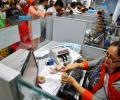
Major Indian banks, including Axis Bank, HDFC Bank, and RBL Bank, have reported a decline in employee headcount in FY26, attributing the reductions to significant investments in technology and automation yielding productivity gains across operations.

International mutual fund schemes have seen a significant resurgence in investor interest, attracting approximately Rs 7,600 crore in net inflows over the past year, a stark reversal from previous outflows, driven by their strong outperformance against domestic markets and limited AI-linked investment opportunities in India.

Indian benchmark indices, Sensex and Nifty, rebounded in early trade after two days of decline, driven by positive global market trends and strong buying in auto stocks. This recovery follows a robust performance in US markets and a rally in Asian markets, particularly Japan's Nikkei, fueled by AI-driven technology optimism. Track Sensex, Nifty on July 1.

'I don't see fear becoming a dominant factor for retail investors.'
Indian benchmark equity indices, Sensex and Nifty, extended their winning streak for a third consecutive day, driven by a rally in IT stocks and global cues suggesting a more accommodative monetary policy after softer-than-expected US jobs data.

Indian benchmark indices, Sensex and Nifty, extended their rally for the fourth consecutive day, driven by a significant drop in crude oil prices and strong performance from IT firms, despite mixed global cues.

Indian stock market benchmark indices Sensex and Nifty closed nearly one per cent higher, extending their winning streak for a second day. This rally was driven by softening crude oil prices, positive geopolitical developments, and significant buying in blue-chip IT stocks, despite a broader global tech sell-off.
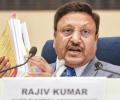
It is because dealing with a regulatory system that is largely headed by retired IAS officers then becomes relatively easy, points out A K Bhattacharya.

Prism, the parent company of OYO, has filed updated draft papers with Sebi for a Rs 6,650 crore initial public offering (IPO) consisting entirely of a fresh issue of shares, with no offer-for-sale component from existing investors.

Smallcap funds give investors access to businesses that can grow much faster than the broader economy.

The asymmetry in deposit and credit growth is the biggest challenge before the Indian banking industry. For every 100 deposit that a bank mobilises, it needs to keep 3 with the banking regulator in the form of cash reserve ratio on which it doesn't earn any interest. Another 18 is used for buying government bonds (statutory liquidity ratio). This means, a bank is left with 79 for giving credit. Add to this, its capital which can be used for giving loans. Most banks are facing a fund crunch. They need to find ways to attract deposits if they want to sustain credit growth, explains Tamal Bandyopadhyay.

According to pollster Pradeep Gupta, years of TMC "misrule" that created a "climate of fear", Prime Minister Narendra Modi's charisma and the organisational abilities of Amit Shah and the RSS brought the BJP to power in West Bengal.

Indian benchmark indices, Sensex and Nifty, experienced a significant drop of over 1 per cent, driven by a bearish trend in global markets, weakness in HDFC Bank and IT firms, and fresh foreign fund outflows.

Despite the Reserve Bank of India's (RBI) and the government's recent initiatives to attract foreign capital, which are expected to alleviate pressure on long-duration bonds, most debt fund managers are maintaining a cautious stance, favouring shorter-duration papers due to global uncertainties and potential future rate hikes.

Multiple exit polls predict a victory for the NDA alliance in the Bihar Assembly elections, with forecasts of a disappointing debut for Prashant Kishor's Jan Suraaj party.

Indian stock markets extended their gains for a second consecutive session, with the Sensex closing 736 points higher, driven by a global equity rally and a significant drop in crude oil prices following the finalisation of a peace deal between the US and Iran to end their 107-day conflict and reopen the Strait of Hormuz.

The case for long-term investment in gold, however, remains intact.

Exit polls predict a BJP victory in Assam and an edge in West Bengal, a DMK government in Tamil Nadu, and a Congress-led UDF comeback in Kerala.

Major life insurers in India reported close to double-digit growth in the value of new business (VNB) last financial year, primarily driven by increased sales of high-margin protection and non-participating (non-par) products.
Indian benchmark equity indices Sensex and Nifty closed higher, recovering from previous losses, driven by a global market rebound, a pause in Israel-Iran hostilities, and a rally in bank stocks.

With Uttar Pradesh assembly elections approaching, an analyst suggests the BJP is in a strong position. Meanwhile, Punjab's political landscape is described as fluid with mixed public satisfaction towards the ruling AAP.

Concerns are rising about the status of GalaxEye Space's Mission Drishti, India's first Made in India OptoSAR satellite, launched on May 3. Reports suggest the satellite is tumbling in space, and experts highlight potential issues with solar panel deployment and stabilisation. The company has remained silent on the matter, fueling further speculation.

Indian benchmark indices Sensex and Nifty experienced a significant slump in early trade, mirroring a sharp decline in global equities and a fresh spike in crude oil prices, exacerbated by simmering tensions in West Asia and a global unwinding of the AI-led rally. Track how sensex, Nifty fared on June 8.

The SIF vertical, which allows MFs to offer complex products to relatively sophisticated investors, has managed to garner scale in just seven months of the launch of the first products.

Much will depend on how the protagonists use the current interlude to work proactively for the beginning of a durable settlement or, on the contrary, prepare for a new round of escalation, points out Ambassador M K Bhadrakumar.
Indian benchmark indices Sensex and Nifty closed marginally lower due to profit-taking, following the Reserve Bank of India's decision to keep the repo rate unchanged while lowering its growth expectations for the current fiscal year and forecasting higher inflation.

The rejection of senior Congress leader Meenakshi Natarajan's nomination papers transformed what should have been a routine Rajya Sabha election into a lesson in contemporary political warfare.

Russian President Vladimir Putin and Chinese President Xi Jinping have reaffirmed their commitment to dismantling global hegemonism and building a 'multipolar world' during high-level talks in Beijing.

'Tamil Nadu has 42% of its population in the 18 to 39 age group. The bulk of the population in this age group voted for Vijay and women voters too voted for him in big numbers.'

Pollster Pradeep Gupta predicts the BJP's current political dominance, which began in 2014, is likely to last at least 20 years, drawing parallels with the Congress's long period of power.

Following Axis Max Life Insurance's second-quarter results for 2025-26, Sumit Madan, managing director and chief executive officer of the company, speaks to Aathira Varier and Subrata Panda/Business Standard about growth aspirations, strategies to offset the impact of the input tax credit (ITC) withdrawal, reverse merger plans, and more.
